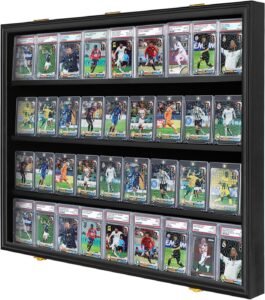
So you have a card you think is worth grading. Maybe it’s a PSA 10 Charizard waiting to happen, a mint-condition rookie pull, or a vintage piece you’ve been sitting on for years. The problem is, you’re staring at three logos — PSA, BGS, and CGC — and you have no idea which one to send it to.
Each grading company has its own standards, its own slab design, its own price points, and its own reputation in the market. Picking the wrong one can cost you real money on resale. This guide breaks it all down so you know exactly where to send your cards in 2026.
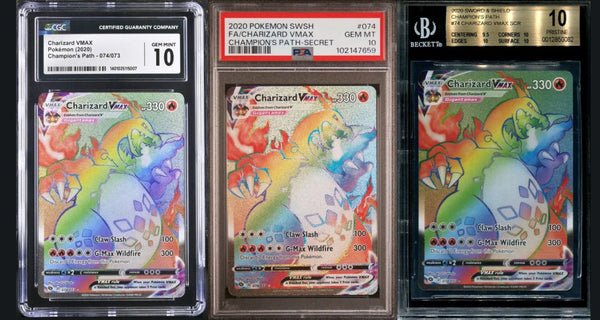
What Is Card Grading and Why Does It Matter?
Card grading is the process of sending your trading card to a third-party company, who inspect it under magnification and assign it a numerical grade based on its condition. The card is then sealed in a tamper-evident plastic case — called a “slab” — with a label displaying the grade and a certification number.
A graded card in a slab commands significantly more value than a raw (ungraded) card. A raw near-mint Charizard VMAX might sell for $80. The same card with a PSA 10 grade can fetch $200 or more. For vintage cards, the difference is even more dramatic — a raw 1st Edition Base Set Charizard might sell for $10,000 ungraded, while a PSA 10 version has sold for over $500,000.
Grading also authenticates the card. With counterfeit cards flooding the market, a graded slab from a reputable company gives buyers total confidence they’re getting the real thing.
The Four Factors Graders Look At
Every major grading company evaluates cards on four core criteria:
- Centering — How well the printed image is centered within the card borders. Even a fraction off can drop your grade.
- Corners — Any fraying, bending, or wear on the four corners of the card.
- Edges — Chips, nicks, or roughness along the card’s four sides.
- Surface — Scratches, print lines, dents, or loss of gloss on the front or back of the card.
These four categories are where PSA, BGS, and CGC diverge dramatically in how they apply their standards.
PSA — Professional Sports Authenticator
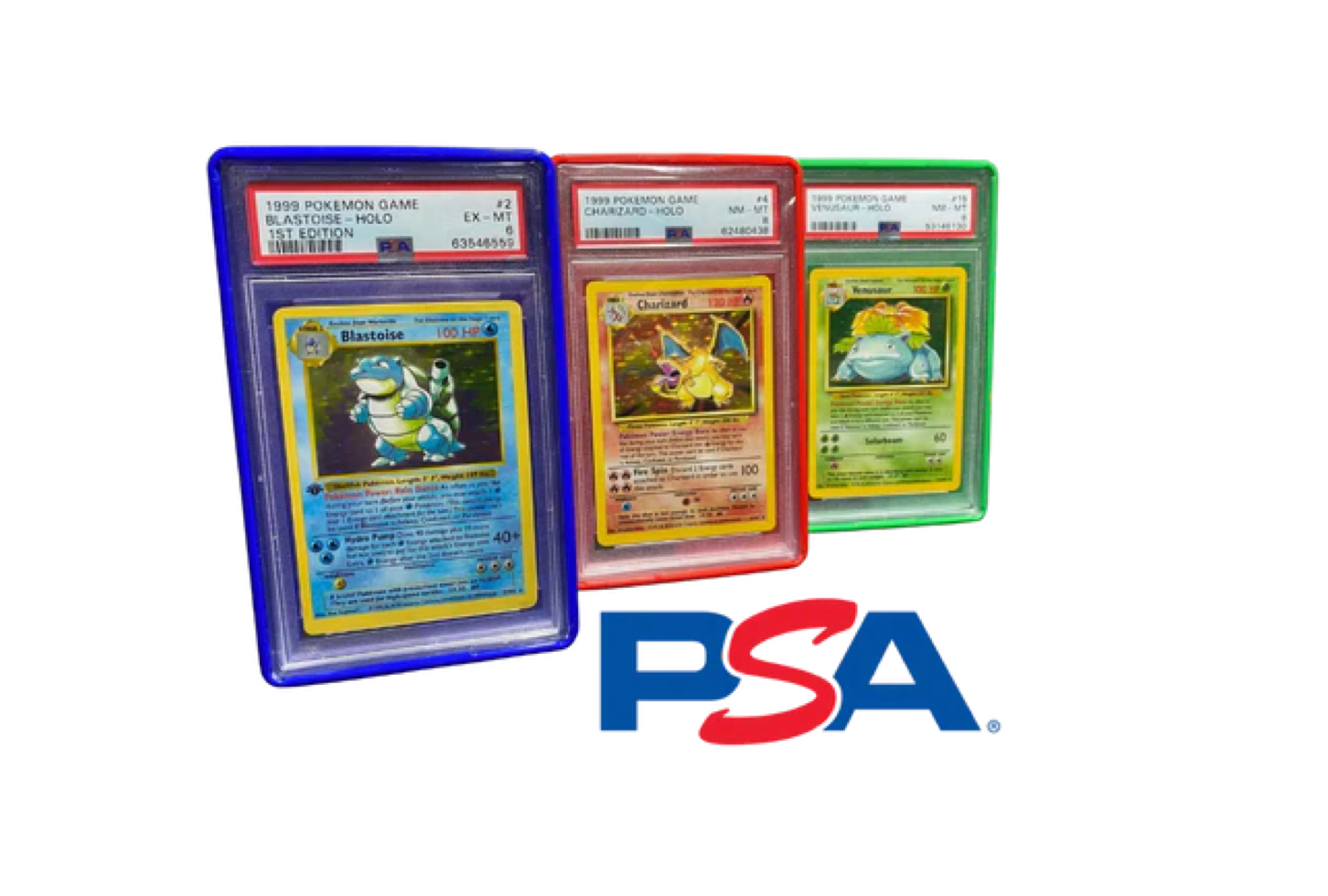
PSA is the undisputed king of card grading. Founded in 1991, they have graded over 75 million collectibles and their red label slab is the most recognised in the entire hobby. If you’re planning to sell a graded card and want the highest possible price, PSA is almost always your best bet.
PSA Grading Scale
PSA uses a simple 1–10 numeric scale with a single overall grade. There are no subgrades on a standard PSA label — just one number. This simplicity is part of what makes PSA so collector-friendly and easy to trade.
| Grade | Label | Condition |
|---|---|---|
| 10 | Gem Mint | Perfect in every way |
| 9 | Mint | Only the slightest imperfections |
| 8 | Near Mint–Mint | Minor wear, still sharp |
| 7 | Near Mint | Light play wear, no major defects |
| 6 | Excellent–Mint | Slight surface wear visible |
| 5 | Excellent | Some rounding of corners |
| 4 | Very Good–Excellent | Obvious wear, still presentable |
| 1–3 | Poor to Good | Heavy wear, creases, damage |
PSA Pros and Cons
- Highest resale value — PSA 10s consistently outsell equivalent grades from BGS or CGC by 5–20%
- Easiest 10 to achieve — PSA is generally considered the most lenient of the three on centering
- Most recognised brand — buyers trust the red label universally
- No subgrades — you won’t know which specific area dropped your grade
- Slower turnarounds — standard service can take 6–9 months in 2026
- Higher cost — bulk economy service starts around $22–25 per card
BGS — Beckett Grading Services
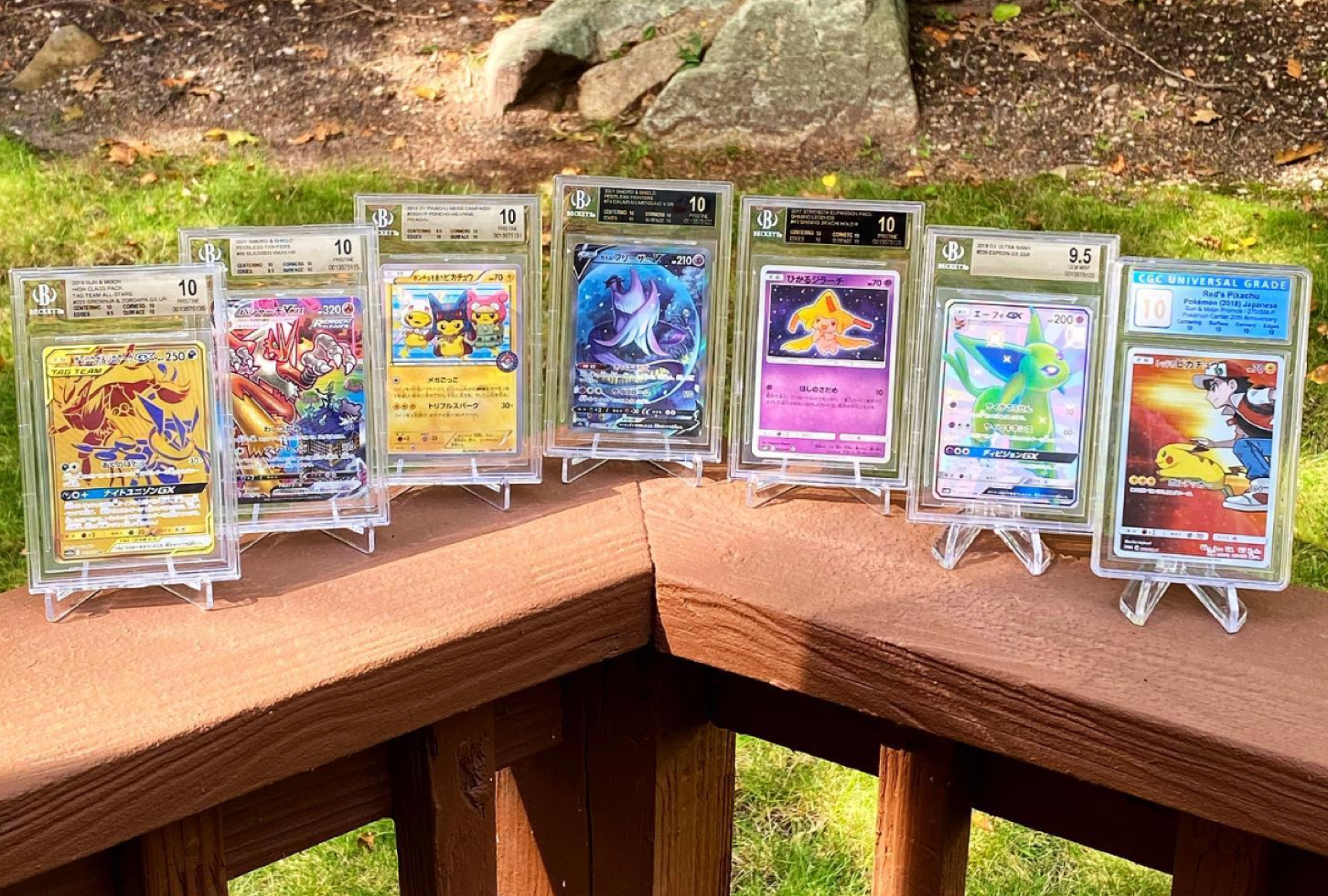
Beckett Grading Services has been grading cards since 1999 and is the only major company to offer detailed subgrades on every card it grades. BGS slabs feature a metallic label that changes colour depending on the grade achieved, and the prestigious BGS Black Label is widely considered the most desirable slab in the entire hobby.
BGS Grading Scale and Subgrades
BGS grades on a 10-point scale but breaks it into four subgrades — Centering, Corners, Edges, and Surface — each scored individually. The overall BGS grade is the lowest of the four subgrades, which means a single weak spot can drag your entire grade down.
| Grade | Label Colour | Rarity |
|---|---|---|
| 10 Pristine (Black Label) | Black | Extremely rare — requires all four subgrades to be 10 |
| 10 Pristine (Gold Label) | Gold | All subgrades must be 9.5 or higher |
| 9.5 Gem Mint | Gold | Near-perfect, most modern cards aim here |
| 9 | Silver | One slightly weak subgrade |
| 8.5 | Silver | Two or more borderline subgrades |
| 8 | White | Visible wear in one area |
| Below 8 | White | Clear wear, play damage |
The BGS Black Label is extraordinarily rare. Only 1–3% of all BGS 10 Pristines receive the black label, meaning every single subgrade must be a perfect 10. When one does surface, it frequently sells for more than the equivalent PSA 10.
BGS Pros and Cons
- Detailed subgrades — you know exactly what cost you the perfect grade
- Black Label premium — the rarest and most valuable slab in the hobby
- Hardest 10 to achieve — BGS Pristine is significantly more difficult than PSA 10
- Slightly lower resale than PSA — BGS 9.5 typically sells for less than PSA 10
- Better for condition-sensitive buyers — collectors who want the full picture love subgrades
CGC Cards
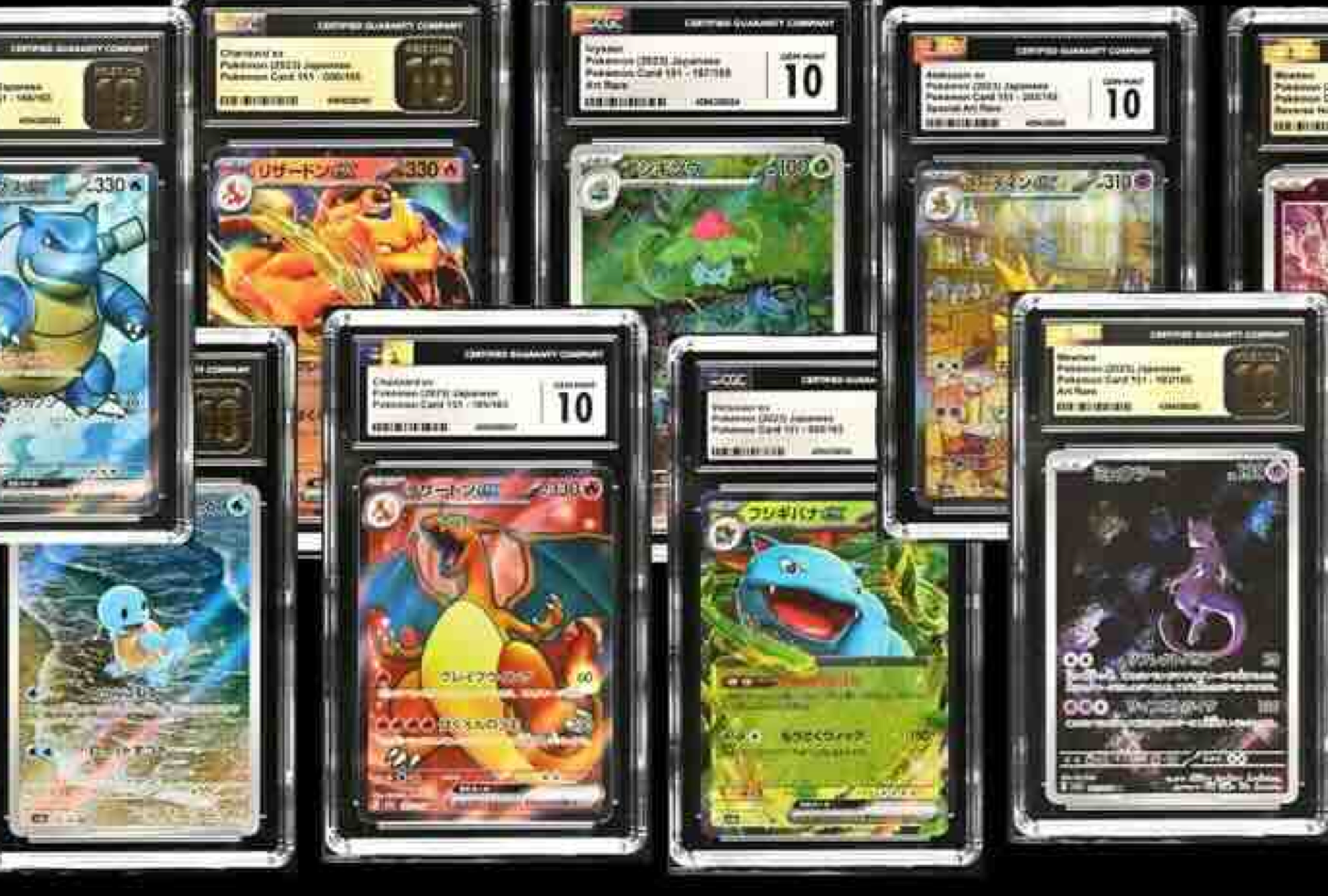
CGC Cards launched in 2020 as an extension of CGC Comics — the most trusted name in comic book grading — and has grown at a remarkable pace. By 2025, CGC captured roughly 25% of the trading card grading market, and their aggressive pricing, consistent standards, and faster turnaround times have made them the go-to choice for TCG players grading modern pulls.
CGC Grading Scale — Two Tier 10 System
CGC uses the most granular grading system of the three. Crucially, they operate a two-tier 10 system — something unique in the hobby:
| Grade | Label | Meaning |
|---|---|---|
| 10 Pristine | Gold | Absolutely flawless — stricter than PSA 10 |
| 10 Gem Mint | Blue | Near-perfect, minor imperfections allowed |
| 9.5 | Blue | Excellent condition, one slight flaw |
| 9 | Blue | Very good, minor wear in one area |
| 8.5 | Blue | Good condition, some visible wear |
| 8 | Blue | Visible wear across one or more areas |
| Below 8 | Blue | Increasing play wear and damage |
The CGC Pristine 10 is harder to achieve than a PSA 10, while the CGC Gem Mint 10 sits roughly equivalent to PSA 10. This two-tier system means a CGC 10 label tells you more about the card than a single PSA 10 does.
CGC Pros and Cons
- Best pricing — bulk economy tiers are cheaper than PSA and BGS
- Fastest growth — CGC is rapidly building market trust and resale momentum
- Two-tier 10 system — more nuanced than PSA, easier to understand than BGS subgrades
- Lower resale than PSA currently — the PSA premium still exists in 2026, though it’s shrinking
- Great for TCG and Pokemon specifically — CGC has aggressively courted the TCG community
- Slower bulk tiers — bulk economy can take up to 120 business days
Head-to-Head Comparison

| PSA | BGS | CGC | |
|---|---|---|---|
| Founded | 1991 | 1999 | 2020 |
| Grading Scale | 1–10 | 1–10 with 4 subgrades | 1–10 (two-tier 10) |
| Resale Value | Highest | Mid (Black Label = highest) | Growing |
| Difficulty for 10 | Moderate | Very Hard | Hard (Pristine) / Moderate (Gem Mint) |
| Economy Cost | ~$22–25/card | ~$20/card | ~$14–18/card |
| Standard Turnaround | 6–9 months | 60–90 days | 18–120 days depending on tier |
| Subgrades | No | Yes (4 categories) | No |
| Best For | Vintage, high-value cards | Condition-conscious collectors | Modern TCG, Pokemon, budget submissions |
How to Submit Your Cards for Grading
The submission process is similar across all three companies. Here’s the general workflow:
- Create an account on the grading company’s website (PSACard.com, Beckett.com, or CGCCards.com)
- Choose your service tier based on the card’s value and how fast you need it back. Higher tiers cost more but return faster.
- Declare the card’s value — this determines your insurance coverage during shipping
- Package your cards carefully — each card should be in a penny sleeve inside a rigid top loader or semi-rigid card saver. Never send raw cards loose.
- Fill out the submission form with each card’s details — set name, year, card number, and declared value
- Ship to the grading company using a tracked and insured courier. Always use signature confirmation.
- Wait for grading and return — you’ll receive email notifications when your submission is received, graded, and shipped back
What Cards Are Worth Grading?
Not every card is worth the cost of grading. The general rule of thumb is that a card’s raw value should be at least 2–3x the cost of the grading service before it makes financial sense to submit. If you’re paying $22 per card to PSA, the raw card should be worth at least $50–60 in near-mint condition for grading to potentially be profitable.
Cards that are almost always worth grading:
- Vintage base set cards (1999 Pokemon Base Set, original Magic: The Gathering)
- First edition holofoils from any popular set
- Secret Rare and alt-art cards from modern sets worth $80+ raw
- Rookie cards of major sports stars
- 1st print run cards with strong collector demand
Which Grading Company Should You Choose?
Here’s the straightforward answer for 2026:
Choose PSA if: You want maximum resale value, you’re grading a high-value vintage card, or you plan to sell the slab on the secondary market and need the most widely recognised brand behind it. The extra cost and wait time is worth it for cards worth $200+ raw.
Choose BGS if: You want detailed condition information, you’re chasing the legendary Black Label, or you specifically collect BGS slabs. BGS is also faster than PSA for standard tiers. If you hit that Black Label, you’ve got the most coveted slab in the hobby.
Choose CGC if: You’re submitting modern TCG cards like Pokemon, One Piece, or Lorcana. CGC is the most affordable option, has the fastest-growing resale market for TCG specifically, and their two-tier 10 system is excellent for understanding exactly what you have. For bulk submissions of modern pulls, CGC wins on cost and consistency.
Keep Reading: How to Spot Fake Trading Cards: 6 Tests That Actually Work · Pitch Black Chase Cards: Most Valuable Pulls (Pokémon TCG) · Best Display Cases for Funko Pops, Cards & Collectibles (2026) · More Collectibles Guides
Final Verdict
The grading company you choose should depend entirely on what you’re submitting and what you plan to do with it. PSA remains the premium choice for high-value cards where resale price is everything. BGS is for the collector who wants maximum data and is chasing grading perfection. CGC is the smart play for modern TCG collectors who want consistent, affordable grading with a company that’s clearly on the rise.
The worst decision you can make is not grading at all — sitting on a mint-condition valuable card in a top loader is leaving money on the table. Pick the service that fits your budget and timeline and get those cards slabbed.
Frequently Asked Questions
Which card grading company is the most recognized?
PSA (Professional Sports Authenticator), founded in 1991, having graded over 75 million collectibles — its red label slab is the most recognized in the hobby.
What grading scale does PSA use?
A simple 1-10 numeric scale with a single overall grade and no subgrades — PSA 10 is Gem Mint, PSA 9 is Mint, and PSA 8 is Near Mint-Mint.
Should I use PSA if I want to sell a graded card for the highest price?
Yes — PSA is almost always the best bet if maximizing resale price is the goal.
Does this guide compare PSA to BGS and CGC?
Yes — it has a dedicated ‘Head-to-Head Comparison’ section covering all three, plus guidance on which company to choose and how to submit cards for grading.




Everything we recommend, curated in one place — from anime merch to gaming gear and snacks.