A single piece of cardboard can sell for $50,000. A booster pack bought thirty years ago might contain a card now worth more than a car. Magic: The Gathering, the world’s oldest and largest trading card game, has developed one of the most complex secondary economies in hobby history. Understanding why rare cards command the prices they do requires examining scarcity, institutional decisions, speculative markets, and the psychology of collecting — all intersecting over three decades of print runs.
The Foundation: How Print Runs Create Scarcity
Magic: The Gathering launched in 1993, published by Wizards of the Coast. The original Alpha print run — the very first edition — consisted of approximately 2.6 million cards across 295 unique designs. Beta, printed shortly after, added another 7.3 million cards. These numbers sound large until you divide them by the number of players worldwide over thirty years and account for cards that were damaged, discarded, or simply lost.
In those early sets, the most powerful cards — Black Lotus, the five Moxen, Timetwister, Ancestral Recall, and Time Walk, collectively known as the Power Nine — were printed in quantities estimated between 1,000 and 22,000 copies depending on edition. Today, demand for those cards runs into the hundreds of thousands of players. The supply-demand imbalance is structurally permanent and only grows over time as new players enter the game.
The Reserved List: Wizards of the Coast’s Price Floor
In 1996, following the release of Chronicles — a set that reprinted powerful older cards and caused their prices to collapse — Wizards of the Coast introduced the Reserved List. This was a formal, public commitment never to reprint specific cards in their original form. The list was created to protect the investments of collectors who had paid premium prices for original printings.
The Reserved List functions as an institutional price floor. Because Wizards cannot legally reprint these cards in standard booster products, supply is permanently capped at whatever exists from original print runs. Every Reserved List card that is graded, sleeved, and placed in a collection rather than played reduces the liquid supply available to buyers further. Black Lotus, the single most recognised card in the game’s history, has sold at auction for over $540,000 in a PSA 10 graded condition — a price driven almost entirely by the guarantee that no new copies will ever enter the market.
The Secondary Market: How Cards Are Priced
Magic cards do not have fixed prices after purchase. The secondary market — primarily operating through platforms such as TCGPlayer, Card Kingdom, and CardMarket in Europe — functions as a continuous auction where prices reflect real-time supply and demand. Sellers list individual cards at competitive prices; buyers filter by condition, edition, and language. Market prices update daily.
Several factors determine a card’s secondary market value. Playability is primary: a card that appears in competitive decks across multiple formats generates sustained demand. Scarcity is secondary: older sets with lower print runs command premiums over functionally identical reprints. Condition is tertiary: a Mint or Near Mint card sells for significantly more than a Lightly Played copy of the same card. Edition matters, too — an Alpha Black Lotus is worth multiples of a Beta Black Lotus, despite identical text, because Alpha’s unique rounded corners and limited print run confer additional scarcity and prestige.
Speculation and Buyouts: The Volatile Side of the Market
Because the MTG secondary market is liquid and transparent, it is also susceptible to speculation. A common pattern, known as a buyout, occurs when an organised group of buyers purchases every available copy of a low-supply card within a short window. The sudden removal of supply from the market forces the listed price upward, after which speculators sell into the new price level. Cards that were $10 can reach $80 overnight through coordinated buyouts, then partially retrace as sellers re-enter the market.
The trigger for buyouts is usually a newly published decklist or rules announcement. When a tournament player wins a major event using a previously overlooked card, or when Wizards of the Coast publishes new rules that make an old card newly legal or powerful, buyers move quickly. The information travels through social media and Discord communities at speeds that dwarf the ability of casual sellers to reprice their inventory, creating brief windows of arbitrage opportunity.

Keep Reading: Why Star Wars Will Be Magic: The Gathering's Next Universes Beyond Set · Magic: The Gathering Strixhaven Prerelease Guide — Everything You Need to Know · Pokémon TCG vs Magic: The Gathering — Which Card Game Should You Start?
Professional Grading and Its Effect on Price
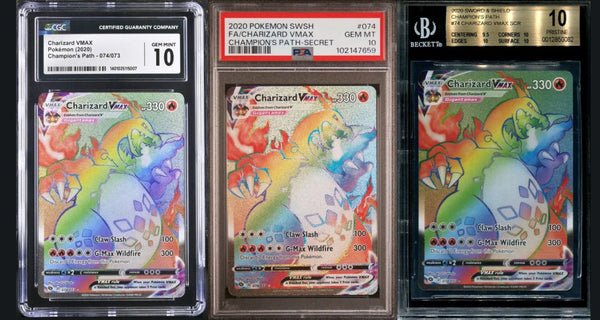
The introduction of professional card grading services — most notably PSA (Professional Sports Authenticator) and BGS (Beckett Grading Services) — imported a mechanism from the sports card market that has had profound effects on MTG card values. A graded card is sealed in a tamper-evident plastic case with an assigned numerical grade from 1 to 10. PSA 10, the highest grade, indicates a card with no visible wear, centering within strict tolerances, and no print defects.
Grading creates stratification within the market for any single card. An ungraded Alpha Black Lotus might sell for $20,000 to $50,000 depending on apparent condition. The same card graded PSA 9 sold for $264,000 in 2021. A PSA 10, of which only a handful are believed to exist, commands prices above $500,000. Grading transforms a subjective assessment of condition into a standardised, tradeable specification — and that standardisation makes ultra-high-grade copies of scarce cards behave more like investment assets than collectibles.
Modern Sets and the Two-Tier Economy
Contemporary Magic operates a two-tier card economy. Standard-legal sets — those printed for the current competitive format — are produced in large quantities and their secondary market prices are relatively modest. A strong rare from a recent set might peak at $30 to $50, but reprints in subsequent products typically drive prices down within months. Wizards actively uses reprints in products such as Commander precons and Masters sets to manage prices for modern cards.
The vintage and legacy card economy operates by entirely different rules. Cards from sets printed before 1999 that appear on the Reserved List cannot be reprinted, and their prices reflect this. The gap between the two tiers is growing: as Wizards prints more copies of modern sets to meet expanded global demand, the relative scarcity of original printings only increases. This has caused the most sought-after vintage cards to appreciate at rates comparable to alternative investment assets, attracting buyers who have no interest in playing the game at all.

What Drives Long-Term Value: A Summary
The economics of rare Magic cards come down to three compounding forces. First, structural scarcity: original print runs were finite, the Reserved List prevents new supply, and attrition steadily removes copies from circulation. Second, persistent demand: thirty years of continuous game development has produced a player base in the tens of millions, all of whom share access to Legacy and Vintage formats that require these cards. Third, institutional legitimacy: professional grading, auction house sales, and media coverage have elevated the most valuable cards into a recognised collectibles category with its own pricing infrastructure.
None of these forces operates in isolation. A card with scarcity but no demand — because it was never powerful in any format — appreciates slowly if at all. A card with demand but no scarcity — because Wizards reprints it freely — will never sustain high prices. It is the combination of permanent supply limits, format relevance, and growing global player base that creates the conditions under which a piece of cardboard printed in 1993 can trade at prices that would have seemed absurd to the players who first cracked open those foil-sealed booster packs.
Keep Reading: Magic: The Gathering Strixhaven Prerelease Guide — Everything You Need to Know · Pokémon TCG vs Magic: The Gathering — Which Card Game Should You Start? · Magic: The Gathering Marvel Super Heroes Set — Everything You Need to Know
Frequently Asked Questions
How much can a single rare MTG card sell for?
A single piece of cardboard can sell for $50,000.
What is the MTG Reserved List?
It’s Wizards of the Coast’s promise never to reprint certain older cards, which helps keep their prices high.
What drives long-term value in MTG cards?
The guide summarizes this in a dedicated closing section, built on scarcity from print runs, the Reserved List, secondary market pricing, and speculation/buyout dynamics.
The Weekly Pull
The biggest card price moves, every Friday.
The cards that jumped or crashed in price this week, plus what’s releasing next. Sign up and get our free Black Friday 2026 price-to-beat cheat sheet. Free. Unsubscribe anytime.
Related Posts:



Talk to us
Got a card, a tip or a request? Email us.
A real person reads every message at hello@nerdsnack.com, and we usually reply within 1–2 business days.
Prefer a form? Use our contact page.
TCGPlayer has the best prices on Magic, Pokemon, Dragon Ball, and Riftbound singles — with seller ratings and buyer protection.