MTG: The Hobbit has some of the highest-value singles of any set released in 2026 — and the market has now had six weeks to settle. The set released August 14, 2026, and this guide was updated September 25, 2026 with post-launch market prices from TCGplayer via Scryfall. Regular copies of most headliners now cost a fraction of their preorder prices. The real money is in the surge foil versions exclusive to Collector Boosters, several of which still sell for $100 to $500+, and the roughly 500-copy Gleaming Gold Smaug, which lists around $24,500. This guide covers every card worth pulling, what its ability actually does (several widely-repeated descriptions of these cards get the rules text wrong — we double-checked every one against Scryfall’s Oracle text), and the price gap between regular and special-treatment versions.
Keep Reading: MTG The Hobbit: What to Buy (Play Booster vs Collector vs Scene Box) · Thorin Commander Deck Guide: Dwarf Equipment Tribal (MTG Hobbit) · Thranduil Commander Deck Guide: Elf Graveyard Recursion (MTG Hobbit) · MTG The Hobbit: All 18 Mythics Ranked From Worst to Best · MTG Star Trek Chase Cards: Most Expensive Cards and What to Pull · MTG Hobbit Book Art Cards: Tyler Jacobson and Ted Nasmith Treatments
Before You Chase: Booster Types Explained
If you’re new to Magic, the prices below only make sense once you know where these cards actually come from. Play Boosters are the standard $5-ish pack sold everywhere — they can contain any rarity but never the surge foil special treatments. Collector Boosters cost roughly triple and are the only product that can contain the special-treatment versions this guide is built around; they also pack a higher density of foils and rares overall. Scene Boxes are a Hobbit-specific product built around one story moment (like the trolls’ campfire scene) and include their own exclusive card treatment, separate from the Collector Booster specials. Commander precons are preconstructed 100-card decks built around a specific legendary creature and don’t award chase-level special treatments at all, though the commander itself is usually a strong card.
A “special treatment” or “chase card” is simply a reprint of a card that already exists with different rules text intact but a redesigned border, frame, or art — same power level, different look. Collectors pay a premium for the look, not the stats. Every card in this guide also comes in a plain nonfoil version and a foil version; foil just adds a holographic finish and typically costs more, sometimes dramatically more on cards that see heavy Commander play.
The Headline Trio: Smaug, Thorin and The Arkenstone
These three were the set’s headline chase cards through preorders. Their surge foil versions only come from Collector Boosters, and while regular copies have fallen hard since launch, the surge foils still hold triple-digit prices. Each is also mechanically strong on its own merits, which keeps demand high even beyond collector appeal.
Collector Booster Exclusives
Prices shown are for the surge foil versions, which only come from Collector Boosters.
Card names under each image link to their current listings on TCGplayer.
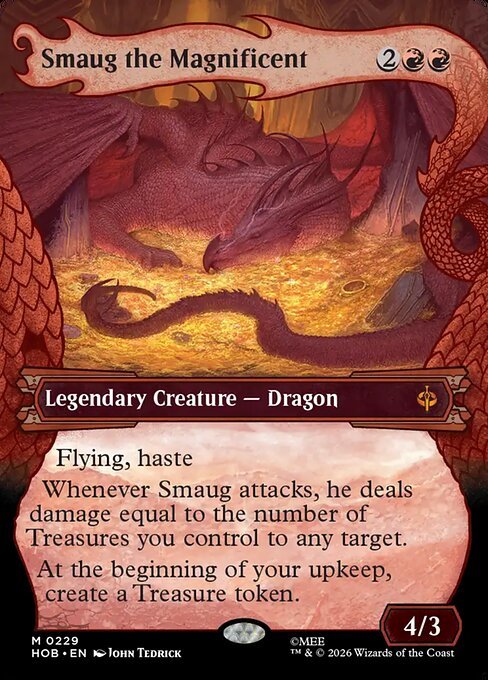
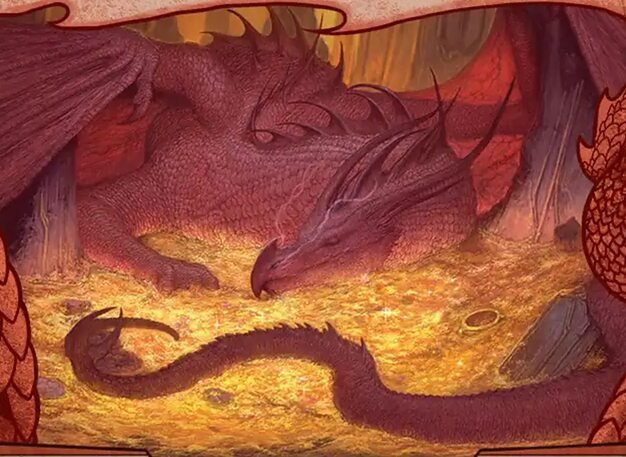
Legendary Creature — Dragon, {2}{R}{R}, mythic. Flying and haste get him into combat the turn he lands. Whenever Smaug attacks, he deals damage equal to your current Treasure count to any target — a player, a blocker, anything. He mints exactly one Treasure at the start of each of your upkeeps, so the burn grows by one every turn he survives; pair him with any other Treasure generator in the format and the damage adds up fast. The surge foil sells for more than ten times the regular printing with identical rules text. The Gleaming Gold “Headliner” printing (#249, about 500 copies) is the set’s ultimate chase at roughly $24,500.
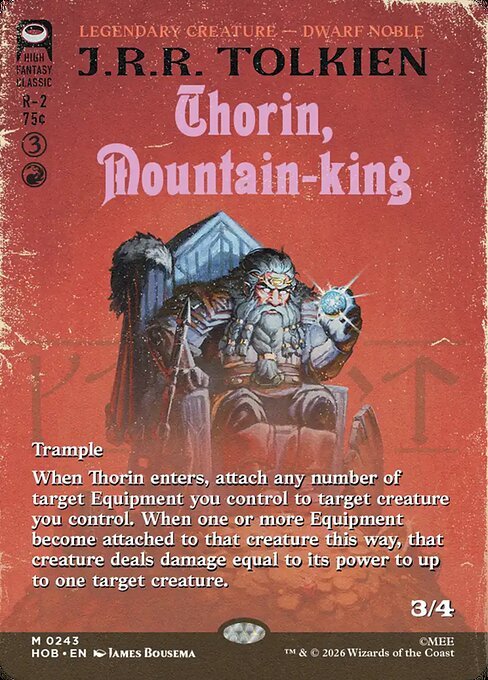
Legendary Creature — Dwarf Noble, {3}{R}, mythic. The set’s marquee Commander. When Thorin enters, you attach any number of Equipment you already control to one target creature at once — no equip costs paid. If that reattachment moves at least one Equipment, the creature immediately deals damage equal to its power to a target creature; it’s a triggered ability, not combat, so it doesn’t need to attack or fight anything. Dwarf Equipment tribal decks want this on curve to dump a whole toolbox and snipe something in the same turn. The surge foil’s roughly $133 premium over the regular version is entirely cosmetic, with the same rules text and power level.
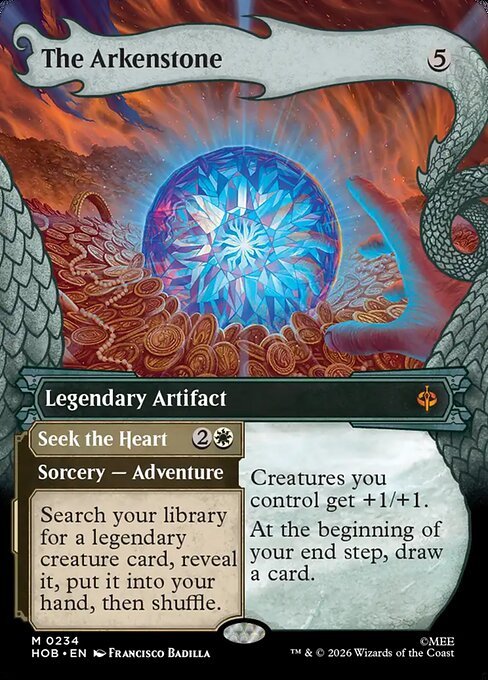
Legendary Artifact // Sorcery — Adventure, {5} // {2}{W}, mythic. The Arkenstone side is a static anthem: your creatures get +1/+1, and you draw a card at the beginning of your end step (your end step only, not every player’s). The Adventure side, Seek the Heart, costs {2}{W} and searches your library for any legendary creature, putting it straight into your hand. Both halves are strong on their own, which is why it slots into almost any white Commander deck. It has two surge foil printings: the showcase version (#270, about $95) and the inverted-frame version (#283, about $217).
Want a shot at pulling these?
Keep Reading: MTG The Hobbit (2026): Every Product, Card Treatment, and Release Date You Need to Know · MTG The Hobbit: What to Buy (Play Booster vs Collector vs Scene Box)
High-Value Pulls: Commander Staples
Below the top three, there are seven more cards with meaningful secondary-market value. These appear in regular and Collector Booster versions and are worth targeting in draft or keeping if you open them — one of them also hides a special-treatment printing that’s easy to miss.
Worth Keeping
These seven cards are not bulk — pull them, sleeve them, and track their prices before trading them away.
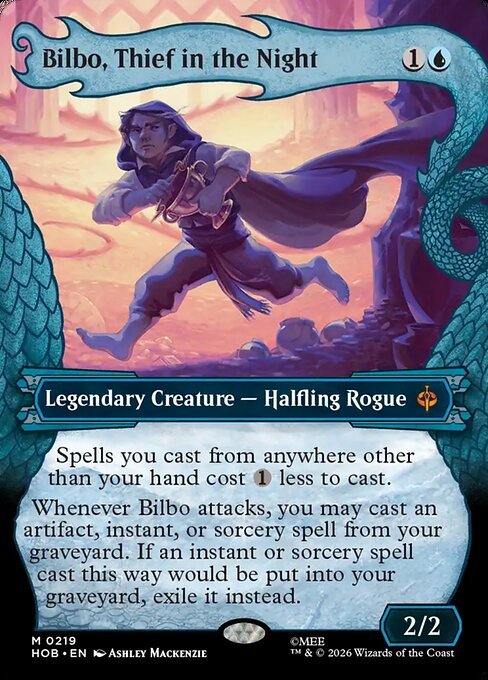
Legendary Creature — Halfling Rogue, {1}{U}, mythic. Spells you cast from anywhere other than your hand cost {1} less — that covers your graveyard, exile, and command zone alike. Whenever Bilbo attacks, you may cast an artifact, instant, or sorcery spell from your graveyard; note it still costs its full mana cost, it’s just legal to cast from the graveyard for the turn, and any instant or sorcery cast this way gets exiled afterward instead of returning to the graveyard, so it’s a one-time reuse, not a loop. The showcase printing (#219) is only about $12, but the surge foil version (#255) sells for around $90, more than ten times the regular card.
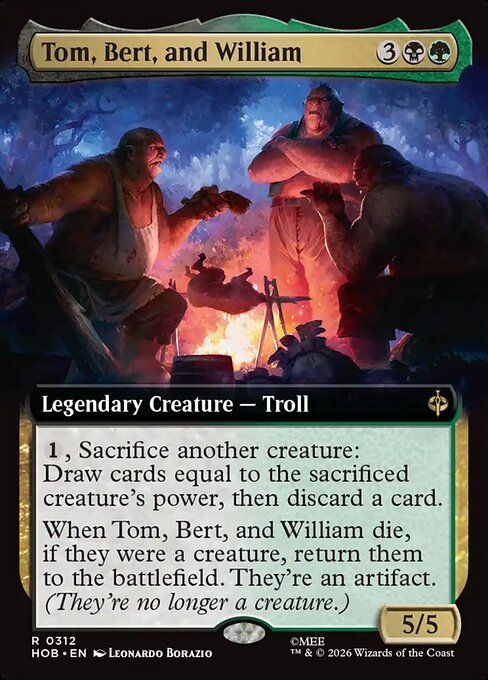
Legendary Creature — Troll, {3}{B}{G}, rare. Pay {1} and sacrifice another creature to draw cards equal to that creature’s power, then discard one — a repeatable card-selection engine as long as you have fodder. When Tom, Bert, and William die while they’re a creature, they return to the battlefield — but as an inert artifact, not a creature, so the sacrifice ability shuts off for good and they can’t attack or block anymore. That’s a direct nod to the book: the three trolls get caught by sunlight and turn to stone. It’s a one-time return, not a recursion loop. The Scene Box exclusive extended-art version (#312) has settled under $1, so this is now a card to play rather than chase.
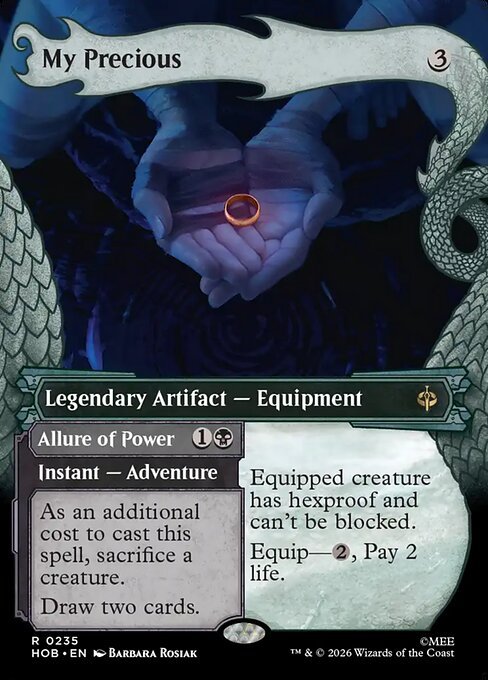
Legendary Artifact — Equipment // Instant — Adventure, {3} // {1}{B}, rare. My Precious grants the equipped creature hexproof and makes it unblockable; Equip costs {2} plus 2 life, a steep but manageable price for turning any creature into an unstoppable threat. The Adventure side, Allure of Power, costs {1}{B} and requires sacrificing a creature as an additional cost to draw two cards — real card advantage, not free, but a fine rate before the Equipment becomes castable from exile. Regular copies are now about $1.36; the surge foil is the only version holding real value, at about $27.
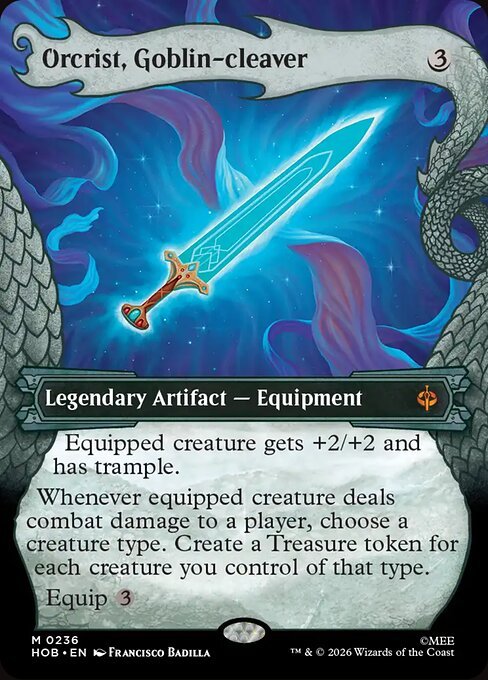
Legendary Artifact — Equipment, {3}, mythic. Equip cost is a steep {3}, but the payoff scales with your board: the equipped creature gets +2/+2 and trample, and connecting with a player lets you name a creature type and mint a Treasure for every creature you control of that type — go wide with one tribe and this snowballs mana fast. It’s Bilbo’s sword from the book, fittingly built around a Goblin-slaying payoff. The regular printing is about $11, the showcase version (#236) about $16, and the surge foil about $87.
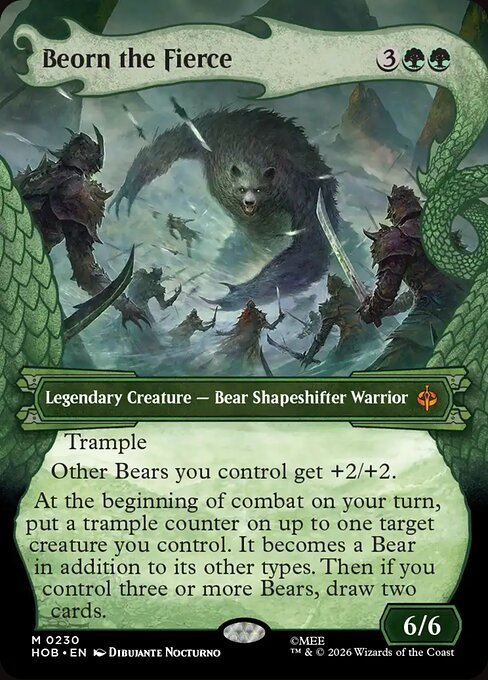
Legendary Creature — Bear Shapeshifter Warrior, {3}{G}{G}, mythic, a 6/6 with trample out of the box. Every combat, Beorn can turn one of your other creatures into an honorary Bear, and once you control three or more Bears, he draws you two cards on top of it. That makes him both a tribal payoff and his own tribe-generation engine — a green Commander deck can go from zero Bears to a card-advantage machine in a couple of turns without needing a dedicated Bear tribal build first.
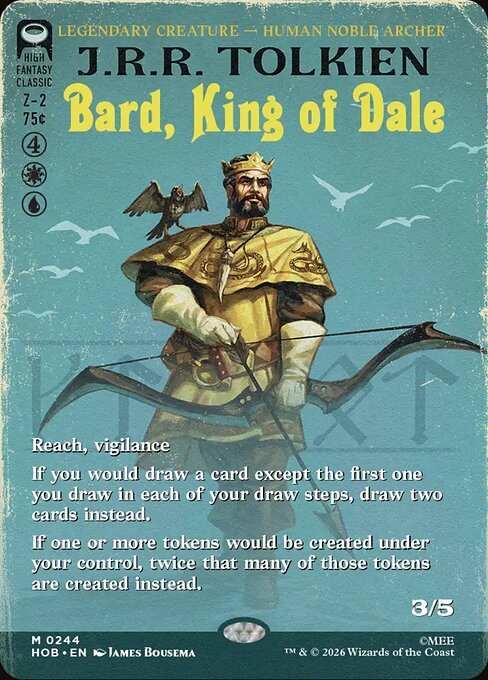
Legendary Creature — Human Noble Archer, {4}{W}{U}, mythic, a 3/5 with reach and vigilance that doubles two of the most common effects in Magic: extra card draw and token generation. Any draw beyond your first each turn becomes two cards, and any token-making effect you control doubles its output — stacking either plan on top of a single Bard turns a modest go-wide or card-draw strategy into a genuinely overwhelming one, which is exactly why it’s drawing early Commander interest despite being just a rare-adjacent mythic pull.
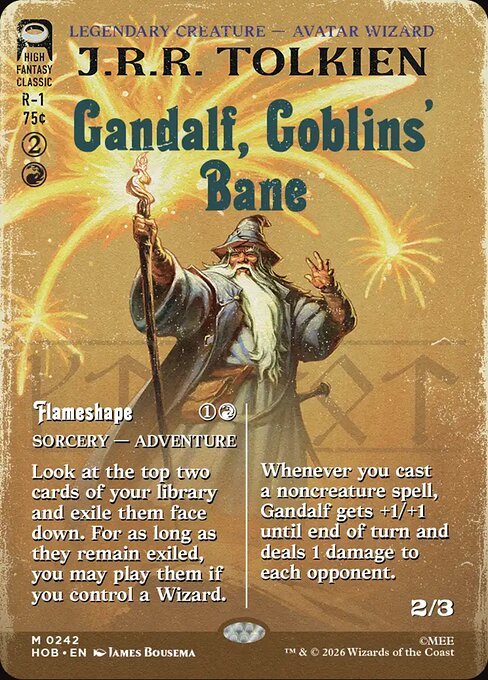
Legendary Creature — Avatar Wizard // Sorcery — Adventure, {2}{R} // {1}{R}, mythic. As a 2/3 for three, every noncreature spell you cast pumps him and pings each opponent for 1 — a spells-matter Commander payoff that adds up fast in a deck full of cheap instants and sorceries. The Adventure side, Flameshape, digs two cards deep and exiles them face down for any Wizard on your side to cast later, giving the card selection a full extra mode before Gandalf ever hits the battlefield as a creature.
More Chase-Worthy Pulls You Might Have Missed
Spoiler-season price guides tend to fixate on the headliners and miss cards like these — several of which are currently priced well into the same range as the Special-Treatment Trio above. These ten didn’t make most “top chase cards” lists when they were first spoiled. Six weeks after launch the results are mixed: Gleaming Splendor and The Queen of Dale are now among the most valuable cards in the set, while Elrond, Inside Information and Desolation of Smaug have settled close to bulk.
Also Worth Watching
Ten more cards to check before you trade away your pulls. Some now outprice the trio; others have dropped close to bulk.
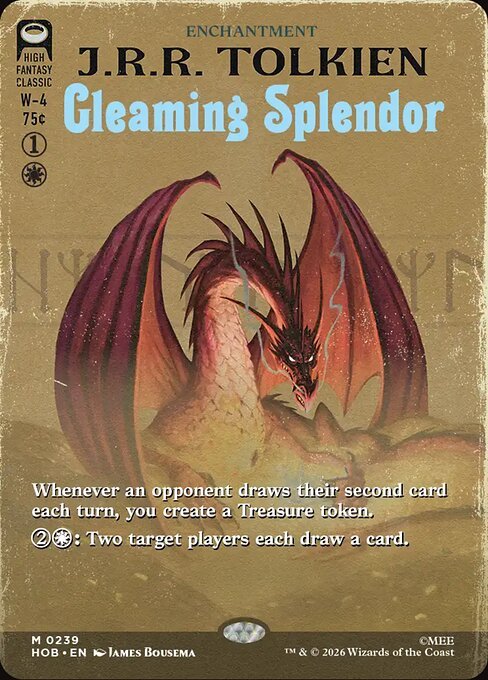
Enchantment, {1}{W}, mythic. A symmetrical-leaning card-draw engine: whenever an opponent draws their second card in a turn, you get a Treasure, and {2}{W} lets you pay to make two players (any two, not necessarily opponents) each draw a card. It rewards decks that lean into extra-draw effects on both sides of the table — group-draw Commander pods in particular. This is the single most expensive card in the set that isn’t a headline legendary, which caught a lot of spoiler-season price guides off guard.
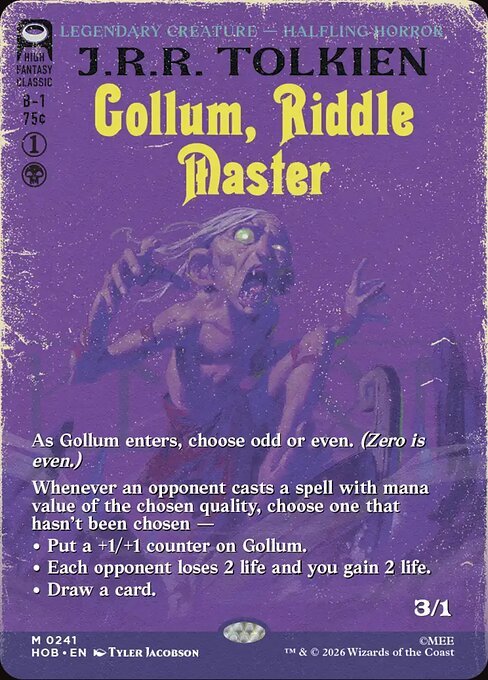
Legendary Creature — Halfling Horror, {1}{B}, mythic, a 3/1 for two. As Gollum enters, you call odd or even; whenever an opponent casts a spell matching that parity, you choose an option that hasn’t been picked yet from a growing +1/+1 counter, a 2-life drain, or a card draw. It snowballs the longer a game goes and punishes opponents for casting spells at all, which is why its surge foil still sits around $136 even though the regular version is under $2.
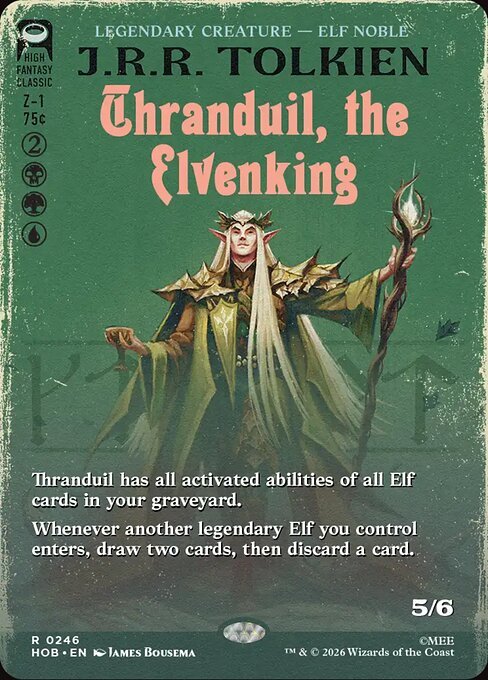
Legendary Creature — Elf Noble, {2}{B}{G}{U}, mythic, a 5/6. This is the same Thranduil that headlines our Sultai Elf-recursion Commander guide — he has every activated ability of every Elf card in your graveyard, and draws you two cards (then makes you discard one) whenever another legendary Elf enters. What a lot of price guides miss is that the surge foil printing runs roughly $86, while the regular version most players build with is under $1.
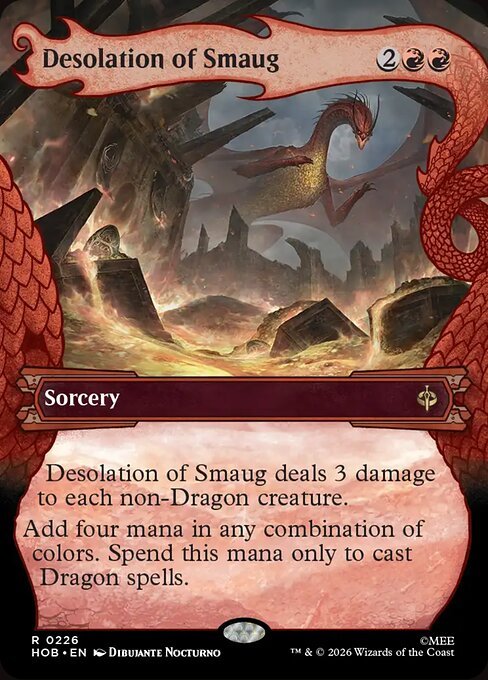
Sorcery, {2}{R}{R}, rare. A one-sided-ish board wipe for Dragon decks: it deals 3 damage to every non-Dragon creature, then adds four mana of any colors that can only be spent on Dragon spells — meaning you can wipe the board and slam a Dragon in the same turn. Smaug the Magnificent is the obvious payoff, but any Dragon typal deck wants a copy.
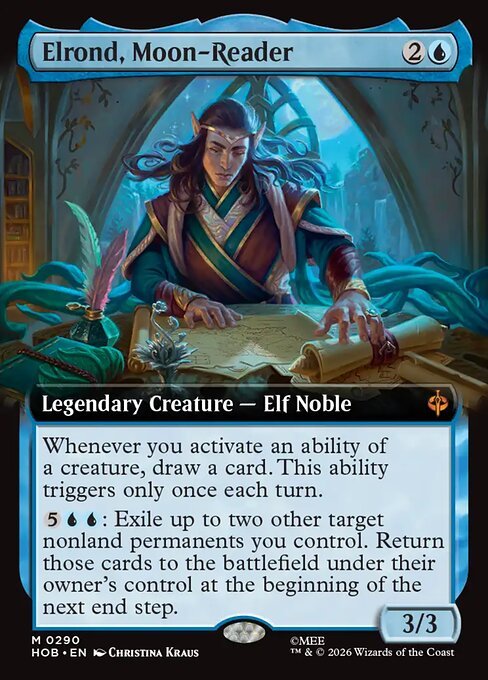
Legendary Creature — Elf Noble, {2}{U}, mythic, a 3/3 for three. Whenever you activate an ability of a creature, you draw a card, once per turn — a low bar in decks full of activated-ability creatures. The {5}{U}{U} flicker ability is the real payoff, blinking up to two of your own nonland permanents to reset enter-the-battlefield triggers or dodge removal at instant speed on your opponent’s turn.
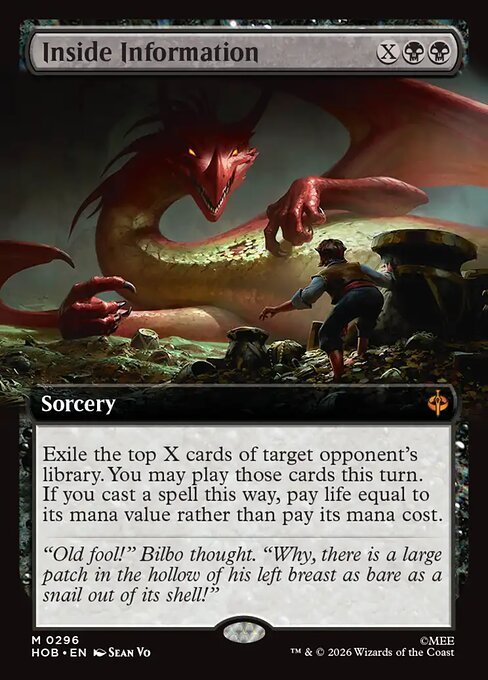
Sorcery, {X}{B}{B}, mythic. Exile the top X cards of an opponent’s library and you may play them this turn — but any spell cast this way costs life equal to its mana value instead of its normal mana cost, letting a big X turn into a genuine alternate win condition in the right deck. It’s a mill-adjacent value spell that can also just end games outright if you hit enough spells.
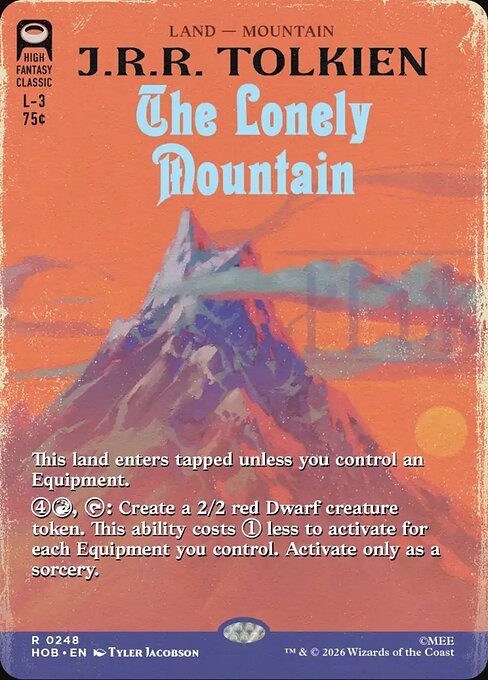
Land — Mountain, rare. Enters tapped unless you control an Equipment, otherwise it’s just a Mountain that taps for {R}. The upside is a late-game token mill: {4}{R} and tap to make a 2/2 red Dwarf, with the activation cost dropping by {1} for every Equipment you control. It slots naturally into the same Dwarf Equipment shell Thorin, Mountain-king wants, which is why collectors are pricing it well above a typical utility land.
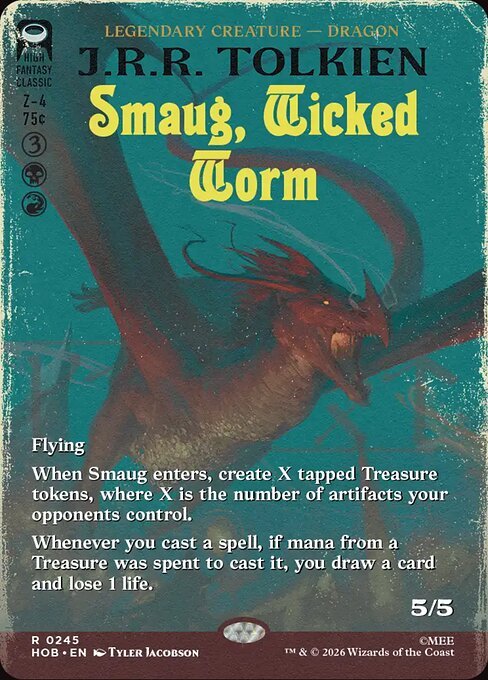
Legendary Creature — Dragon, {3}{B}{R}, rare, a 5/5 flier. On entry, it mints a tapped Treasure for every artifact your opponents control — can be zero, can be a windfall against an artifact-heavy table. Any time you cast a spell using Treasure mana, you draw a card and lose 1 life, turning those Treasures into a card-advantage engine rather than just fixing. The regular printing (#164) is about $1; the surge foil (#281) is the one worth money at about $92.
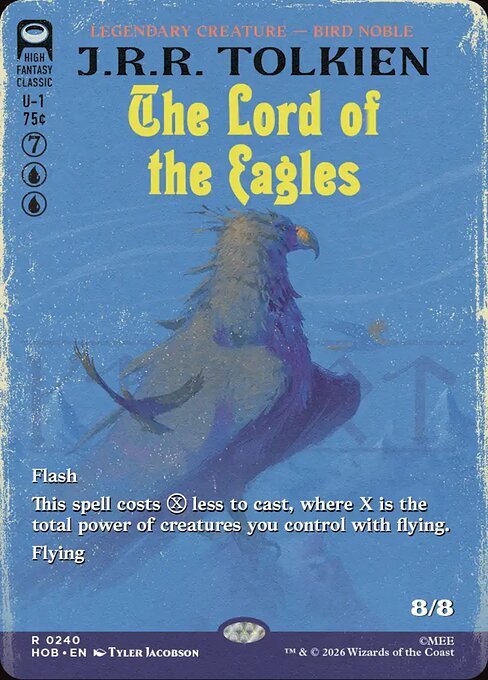
Legendary Creature — Bird Noble, {7}{U}{U}, rare, an 8/8 flier with Flash. Its cost drops by {X}, where X is the total power of creatures you control with flying — in a dedicated flying tribal shell it can come down for a fraction of nine mana, and Flash means it can ambush an attacker or dodge a sorcery-speed board wipe.
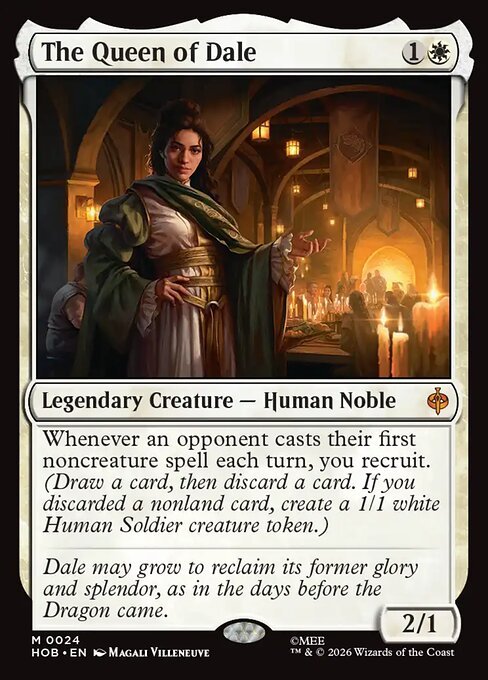
Legendary Creature — Human Noble, {1}{W}, mythic, a 2/1 for two. Whenever an opponent casts their first noncreature spell each turn, you recruit — drawing a card, discarding a card, and making a 1/1 Human Soldier if the discard was nonland. In multiplayer, that can trigger multiple times per round across different opponents, quietly filling your board and hand while everyone else just plays spells.
Ready to crack packs?
Frequently Asked Questions
A card enough players specifically want to open or own — because of secondary-market value, playability, or both — that it drives demand for the whole product. It’s not an official rarity, just a community term.
Nothing on the rules text. Same card, same mana cost, same abilities — only the border, frame, and sometimes the art change. The premium is purely cosmetic and collector-driven.
A lot, for regular copies. The regular Smaug the Magnificent fell from about $184 at presale to about $21.50 by September 25, 2026, and Thorin from about $35 to under $4. Surge foils and the Gleaming Gold Smaug have held their value far better.
Almost never math-favorable — see the tips below. Buying the specific card as a single is nearly always cheaper than gambling on packs to open it.
Foil adds a holographic finish and doesn’t change the rules text at all, but foils of cards that see heavy Commander play — like Bilbo or Gandalf here — often cost significantly more than the plain version.
More Ways to Get Into The Hobbit
Beyond the base Play Booster Box and Bundle, a few more Hobbit-specific products are worth knowing about — a Scene Box with its own exclusive treatments, a ready-built Commander precon, and gear built specifically for this set instead of generic TCG accessories.
Sealed prices have moved since launch, so check today’s price before you buy.
Complete Your Hobbit Collection
How to Chase These Cards

- ▸Buy singles, not packs. The expected value of a Collector Booster does not cover its retail price. If you want Smaug or Thorin, buying the card directly costs less than the packs needed to pull it on average.
- ▸Regular vs. special treatment. The same card exists at a fraction of the price without the special frame. Thorin at $3.77 plays identically to the $137 surge foil. The premium is purely cosmetic.
- ▸Foil versions of the mid-tier cards. Surge foils carry huge multipliers: Bilbo’s is about $90 against a $7.78 regular copy, and Gandalf’s about $214 against $3.92. If you crack a foil copy of either from a Collector Booster, do not trade it for face value. If a pull is worth grading, see our PSA vs BGS vs CGC breakdown before you send anything in.
- ▸Prices settled post-release, as expected. Regular copies of the headliners dropped 70–90% from presale in the six weeks after launch. Surge foils fell far less, so the gap between playing and collecting has never been wider.
- ▸Check prices right before you buy. Prices still shift day to day. Pull up Scryfall or TCGplayer the same day you’re about to purchase, not from a guide written weeks earlier — including this one.
Protect Your Pulls
If you land one of the trio above, it’s worth more than a random top-loader can protect. Sleeve it the day you pull it and give it a real home in a binder built for long-term storage, not a shoebox. See our full card sleeves guide for every format, or grab the two staples below.
Protect Your Pulls
Keep Reading: The 10 Most Valuable MTG Marvel Super Heroes Cards (October 2026) · Most Valuable LOTR MTG Cards: Every Chase Card Worth Knowing · MTG Best LOTR Commander Cards: Building With Middle-earth · Which Recent Pokémon Set Packs Have the Most Value? (Best Value Ranked)
Final Verdict
Where to Buy
As an Amazon Associate, NerdSnack earns from qualifying purchases.
Nerd Snack Monthly
The month ahead, in one email.
Next month’s set releases and prerelease dates, plus the chase cards that moved in price. Free. Unsubscribe anytime.
Related Posts:
Talk to us
Got a card, a tip or a request? Email us.
A real person reads every message at hello@nerdsnack.com, and we usually reply within 1–2 business days.
Prefer a form? Use our contact page.
TCGPlayer has the best prices on Magic, Pokemon, Dragon Ball, and Riftbound singles — with seller ratings and buyer protection.